Menu

Tank vs. Tankless Water Heaters in Washington, D.C. – Expert Analysis for Rowhouses, Condos, and Historic Properties

Washington, D.C. homeowners face unique space and infrastructure challenges when choosing between traditional storage water heaters and on-demand systems. Get the facts to make the right decision for your property.

Slider Image 1
Slider Image 2
Slider Image 3
Slider Image 4
Slider Image 5
Slider Image 7
Slider Image 8
Slider Image 9
Slider Image 10
Slider Image 11

Why Washington, D.C. Homeowners Need to Rethink Water Heater Choices

Washington, D.C. presents specific challenges that make the tank vs tankless water heater comparison more critical than in other cities. The city's aging housing stock includes narrow rowhouses in neighborhoods like Capitol Hill and Dupont Circle where mechanical closets measure barely three feet wide. You cannot fit a standard 50-gallon storage tank where a Victorian-era coal chute once stood.

The city's fluctuating water pressure compounds the issue. D.C. Water reports pressure variations between 40 and 80 PSI across different elevation zones, from Georgetown's bluffs to the low-lying Anacostia waterfront. Conventional tank water heaters handle this inconsistency better than some instantaneous models, which require stable inlet pressure to modulate burner output correctly.

Hard water further complicates the decision. The Potomac River source water contains 120-180 mg/L of calcium carbonate. This mineral content accelerates sediment buildup in traditional vs on-demand water heaters differently. Storage tanks accumulate sediment at the bottom, reducing capacity and efficiency over 5-7 years. Tankless heat exchangers experience scaling on copper fins, which restricts flow and triggers error codes.

Row home layouts create another variable. Your second-floor bathroom sits 40 feet of pipe run from a basement water heater. With a standard tank system, you waste 1.5 gallons waiting for hot water. An instantaneous heater at point-of-use eliminates that waste but requires 240V electrical service where only 120V exists.

The comparison between storage vs instantaneous water heaters depends entirely on your building's infrastructure, your household's usage patterns, and whether you can access gas lines or need electric-only solutions.

Why Washington, D.C. Homeowners Need to Rethink Water Heater Choices
How We Evaluate Tank and Tankless Systems for D.C. Properties

How We Evaluate Tank and Tankless Systems for D.C. Properties

Crestline Plumbing Washington DC approaches the tank vs tankless water heater comparison through building-specific analysis, not sales pressure. We measure actual hot water demand using fixture unit calculations and occupancy patterns. A three-bedroom rowhouse with one full bath has different requirements than a two-story condo with simultaneous shower and dishwasher use.

We start by testing your incoming water pressure at multiple fixtures. If you register below 50 PSI, certain tankless models will not fire consistently. We also check your gas line diameter. Many D.C. rowhouses have 1/2-inch gas mains that cannot support a whole-house tankless unit requiring 180,000 BTU input. Upsizing the gas service from the meter costs thousands before you even install the heater.

For conventional vs tankless water heaters, we calculate recovery rate versus flow rate. A 50-gallon tank with a 40,000 BTU burner recovers 41 gallons per hour at a 90-degree temperature rise. A tankless unit rated for 8 gallons per minute delivers that flow indefinitely, but only if you have adequate gas supply and electrical power for the ignition system and modulating controls.

We inspect your existing venting. Storage tanks use naturally drafting Type B vents. Tankless systems require sealed combustion with PVC or stainless steel venting, which must terminate differently per D.C. building code. If your mechanical room shares a wall with a neighbor in a attached rowhouse, you face additional clearance requirements.

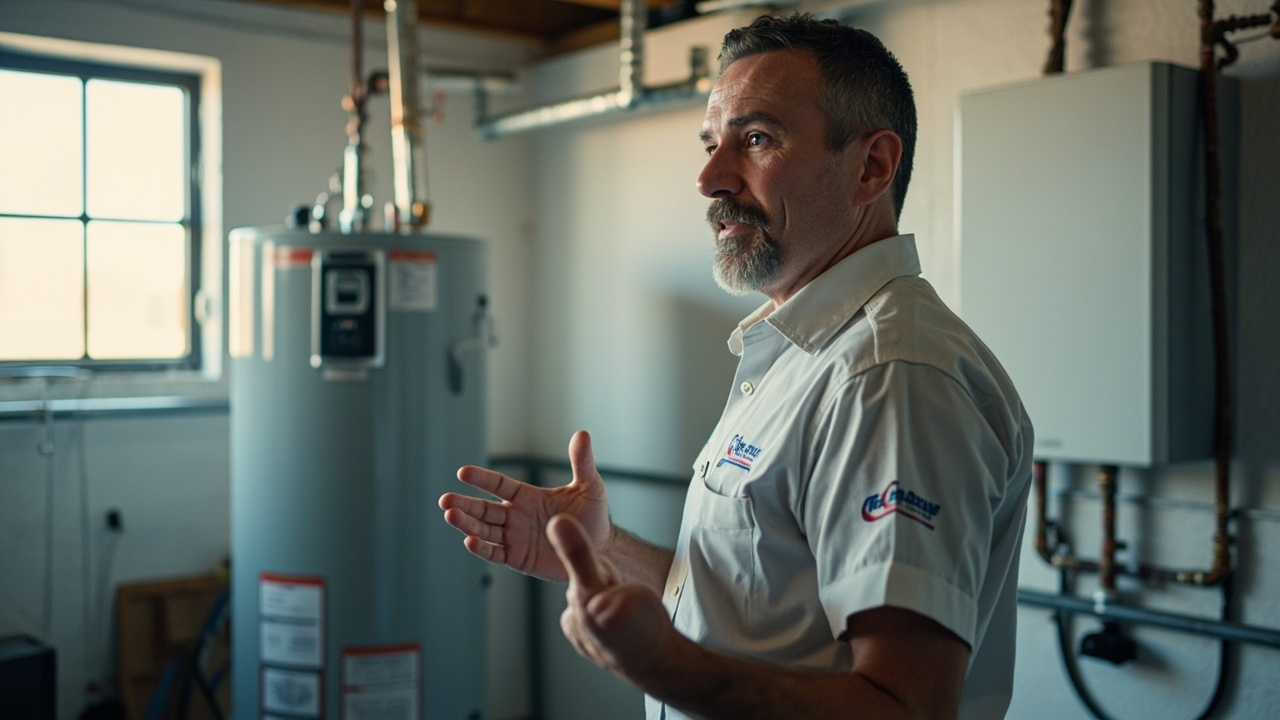
Space limitations drive many decisions. A wall-hung tankless unit occupies 0.15 square feet. A conventional 50-gallon tank needs 4.9 square feet of floor space. In basement mechanical rooms that flood during heavy Potomac basin storms, elevating equipment matters. Tankless units mount 18 inches off the floor. Tanks sit directly on concrete.

What Happens During Your Water Heater Evaluation

Tank vs. Tankless Water Heaters in Washington, D.C. – Expert Analysis for Rowhouses, Condos, and Historic Properties
01

Building Assessment

We inspect your mechanical room dimensions, gas line size, electrical panel capacity, and venting pathway. You receive a written analysis of whether your infrastructure supports tankless installation or requires modification. We document water pressure, incoming water temperature, and distance from heater to fixtures. This determines whether standard vs tankless water heaters will actually meet your performance expectations without expensive upgrades.
02

Usage Analysis

We calculate your peak hour demand by counting fixtures and typical simultaneous usage. A family running two showers, a dishwasher, and a washing machine needs 12 gallons per minute, which exceeds most residential tankless units. We review your current utility bills to project operating costs for both conventional and instantaneous systems based on your actual consumption patterns and D.C. gas and electric rates.
03

System Recommendation

You receive a comparison document showing installed cost, projected annual operating expense, maintenance requirements, and lifespan for both tank and tankless options. We explain trade-offs specific to your property. If your rowhouse cannot support whole-house tankless without a gas service upgrade, we present hybrid solutions like a tank system with a recirculation pump or point-of-use electric tankless for distant fixtures.

Why D.C. Homeowners Trust Our Water Heater Guidance

Washington, D.C. enforces strict mechanical codes through the Department of Consumer and Regulatory Affairs. We pull permits and schedule inspections for every water heater replacement. You avoid the compliance problems that come from unlicensed installers who skip permitting to save time.

Our technicians understand D.C.'s housing archetypes. We have installed systems in Federal-style rowhouses with 10-foot ceilings and cramped basements, mid-century garden apartments with centralized mechanical rooms, and modern condos in converted warehouses. Each building type presents different constraints for the traditional vs on-demand water heaters decision.

We also account for Historic Preservation Review Board requirements. If you own property in a historic district like Georgetown or Capitol Hill, exterior venting changes require approval. Tankless systems sometimes need new vent terminations that alter facade appearance. We design installations that meet code while preserving architectural integrity.

The Potomac basin's water chemistry demands specific equipment choices. We recommend models with stainless steel heat exchangers for tankless units and powered anode rods for storage tanks to combat the mineral content. This extends service life in D.C.'s water conditions compared to standard components.

You also get honest guidance about whether tankless makes financial sense. If you use 40 gallons of hot water daily, a high-efficiency storage tank costs less to install and operates at similar efficiency to a tankless unit. We run the numbers based on your household size and usage rather than pushing the higher-margin product.

Crestline Plumbing Washington DC carries both tank and tankless inventory for same-day installation when needed. You do not wait two weeks for special-order equipment. We stock models sized appropriately for D.C. housing stock, from compact 30-gallon tanks for small condos to 199,000 BTU tankless systems for large homes.

What You Should Know Before Choosing Your System

Installation Timeline

A direct tank-to-tank replacement takes four to six hours, including hauling out the old unit and connecting the new one to existing water, gas, and vent lines. Tankless installations require eight to twelve hours because we upgrade gas lines, install new venting, and add electrical circuits for the control board. DCRA permit approval adds one to three business days before we start work. Emergency replacements for failed heaters happen faster, but you may need temporary electric point-of-use heaters during the permitting window.

System Sizing

We size storage tanks by first-hour rating, not just capacity. A 50-gallon tank with a weak burner delivers less hot water than a 40-gallon model with a powerful heating element. For tankless systems, we calculate required flow rate at your desired temperature rise. Potomac water enters your home at 55 degrees in winter. Heating to 120 degrees requires a 65-degree rise. A family needing 10 gallons per minute requires a unit rated for at least 10 GPM at 65-degree rise, which demands serious gas input.

Operating Efficiency

Modern storage tanks achieve 0.67 to 0.70 energy factor ratings with power venting and thick insulation. Tankless units rate 0.82 to 0.96 energy factor because they eliminate standby loss. However, real-world efficiency depends on usage patterns. Short draws waste energy in tankless systems because the burner fires, heats the exchanger, then shuts off before reaching steady-state combustion. Families with frequent small hot water uses sometimes see better efficiency from well-insulated storage tanks than from improperly sized instantaneous heaters.

Maintenance Requirements

Storage tanks need annual draining to remove sediment that accumulates from D.C.'s hard water. We flush the tank, test the temperature and pressure relief valve, and inspect the anode rod that prevents tank corrosion. Tankless units require annual descaling to remove mineral deposits from the heat exchanger. This involves pumping vinegar or descaling solution through the system for 45 minutes. Skipping this service in D.C.'s water conditions will cause flow restrictions and premature failure. We offer maintenance agreements that cover annual service for both system types.

Frequently Asked Questions

You Have Questions,
We Have Answers

Is it better to have a tank or tankless water heater? +

It depends on your household size and hot water usage patterns. Tank water heaters store 40 to 80 gallons and work well for families who use hot water at predictable times. Tankless units heat water on demand, which saves space and energy over time. In Washington, D.C., where row homes and condos often have limited mechanical room space, tankless models offer a compact advantage. If you have simultaneous demands like running showers and dishwashers, a tank system may deliver more consistent volume. Evaluate your daily gallons used and available square footage before deciding.

What is the downside of a tankless water heater? +

Tankless water heaters require a higher upfront investment, both for the unit and installation. They often need upgraded electrical service or larger gas lines, which adds cost. In older Washington, D.C. homes with outdated wiring or galvanized pipes, retrofitting can become complex. Tankless units also struggle with simultaneous high-demand scenarios unless you install multiple units or a high-capacity model. Mineral buildup from D.C.'s moderately hard water can clog heat exchangers, requiring annual descaling maintenance. If you skip this service, efficiency drops and repairs increase. These factors make tankless less plug-and-play than traditional tank systems.

Why do plumbers not recommend tankless water heaters? +

Some plumbers hesitate to recommend tankless water heaters because installation complexity increases labor time and requires specialized training. Older Washington, D.C. infrastructure often lacks the electrical capacity or gas line size needed for tankless operation, creating costly upgrade requirements. Traditional tank systems are straightforward to install and repair, with widely available parts. Tankless units demand precise venting, specific clearances, and calibration to water hardness levels. If a plumber lacks tankless experience or the homeowner ignores descaling maintenance, performance suffers. Many plumbers prefer recommending what they know works reliably in D.C.'s aging housing stock without added retrofit headaches.

How much does your electric bill go up with a tankless water heater? +

Electric tankless water heaters can increase your bill if used inefficiently, but savings depend on usage habits. Tankless units eliminate standby heat loss, which accounts for 10 to 20 percent of a tank heater's energy waste. However, electric tankless models draw high amperage during operation, spiking demand charges if multiple fixtures run simultaneously. In Washington, D.C., where electricity rates hover around 13 cents per kilowatt-hour, you may see a modest monthly increase unless you stagger hot water use. Gas tankless models typically offer better operating cost savings. Your actual bill change depends on family size and daily gallons consumed.

Do you ever run out of hot water with tankless? +

You rarely run out of hot water with a properly sized tankless unit, but you can exceed its flow rate capacity. Tankless heaters deliver a continuous supply as long as demand stays within the unit's gallon-per-minute rating. If you run two showers, a dishwasher, and a washing machine simultaneously, the flow rate may drop and water temperature can fluctuate. In Washington, D.C., where incoming groundwater temperatures average 55 degrees in winter, the heater works harder to reach 120 degrees, reducing maximum flow. Sizing the unit correctly for peak demand prevents this issue and ensures consistent hot water delivery.

What water heater do plumbers recommend? +

Plumbers typically recommend tank water heaters for reliability, ease of repair, and lower upfront cost. Brands like Rheem, Bradford White, and A.O. Smith dominate the D.C. market because parts are readily available and installation is straightforward. For homes with higher efficiency goals or space constraints, plumbers may suggest tankless models from Rinnai or Navien, provided the electrical or gas infrastructure supports the upgrade. The best choice depends on your home's age, daily hot water consumption, and budget. A qualified plumber will assess your existing system, water hardness, and usage patterns before recommending a specific type and brand.

How D.C.'s Rowhouse Infrastructure Limits Tankless Water Heater Installation

Washington, D.C.'s housing stock predates modern plumbing standards. Most rowhouses built between 1880 and 1940 have 1/2-inch gas mains feeding furnaces and water heaters. A whole-house tankless system needs 3/4-inch to 1-inch gas supply to deliver 150,000 to 199,000 BTU. Upgrading gas service from the meter through interior walls involves Washington Gas, DCRA permits, and potential Historic Preservation review if you live in a protected district. This infrastructure reality makes the conventional vs tankless water heaters decision less about preference and more about physical feasibility in older D.C. neighborhoods.

Crestline Plumbing Washington DC works within the constraints of D.C.'s building codes and historic district regulations daily. We know which tankless models meet DCRA efficiency standards and which venting configurations pass inspection. Our technicians understand the approval process for exterior work in Georgetown, Capitol Hill, and other protected areas. When clients ask about the standard vs tankless water heaters comparison, we provide guidance rooted in local building realities, not manufacturer marketing. You get honest assessments of what your specific property can support and what modifications would cost to make tankless feasible.
Plumbing Services in The Washington DC Area

Our service area is conveniently located to provide fast and efficient plumbing solutions to residents and businesses throughout the Washington DC area. We are dedicated to ensuring that no matter where you are, a trusted and reliable plumber is just a call away. Our map provides a visual representation of our service coverage, helping you to quickly and easily locate our trusted team.

Address:
Crestline Plumbing Washington DC, 1140 3rd St NE, Washington, DC, 20002

Additional Services We Offer

Our news updates

Latest Articles & News from The Blogs

Deciding Between a Tankless or Storage Tank Water Heater for Your Growing Family in Fort Davis Choosing the right water…

Deciding Between a Tankless or Storage Tank Water Heater for Your Growing Family in Fort Davis

Deciding Between a Tankless or Storage Tank Water Heater for Your Growing Family in Fort Davis Choosing the right water…

The Challenges of Adding a Sink to Your Kitchen Island in a Brentwood Rowhome

The Challenges of Adding a Sink to Your Kitchen Island in a Brentwood Rowhome Adding a sink to your kitchen…

How to Choose Between a Vertical and Horizontal Grease Interceptor for Your Navy Yard Restaurant

How to Choose Between a Vertical and Horizontal Grease Interceptor for Your Navy Yard Restaurant Running a restaurant in Navy…

Contact Us

Stop guessing about tank versus tankless. Call Crestline Plumbing Washington DC at (771) 223-8111 for a building-specific evaluation. We measure your infrastructure, calculate your demand, and show you what actually works in your home.